Hotline (also WeChat):
0574-62425361
17757495882
Ningbo Xingma Diesel Nozzle & Pump Co., Ltd.
Committed to quality products and first-class service for customers worldwide


Basic principle of a hydraulic pump
It is a hydraulic component that supplies pressurised fluid for hydraulic transmission, converting the mechanical energy of a prime mover (electric motor or internal combustion engine) into the pressure energy of the fluid.
The cam is rotated by an electric motor. As the cam pushes the plunger upward, the sealed volume formed by plunger and cylinder decreases and oil is forced out through a check valve to where it is needed.
As the cam rotates to the falling part of its profile, a spring forces the plunger down, creating a partial vacuum so that oil from the tank enters the sealed chamber under atmospheric pressure. The continuous rise and fall of the plunger cyclically decreases and increases the sealed volume, so the pump continuously draws in and discharges oil.
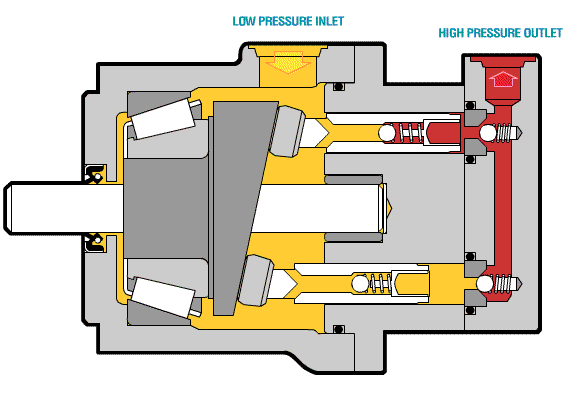
Working principle diagram of a hydraulic plunger pump
Gear pumps: compact, simple in structure, tolerant of oil cleanliness and inexpensive; but the shaft is subject to unbalanced forces, leading to significant wear and leakage.
Vane pumps: available as double-acting and single-acting types; they deliver uniform flow, run smoothly and quietly, and offer higher working pressure and volumetric efficiency than gear pumps, though with a more complex structure.
Plunger pumps: high volumetric efficiency, low leakage, capable of high pressure and mostly used in high-power hydraulic systems; but complex in structure, demanding in materials and machining accuracy, expensive and requiring clean oil.

 Nationwide Service Hotline
No. 2 Handa Road, Mazhu Town, Yuyao, Ningbo
sale@xmdiesel.com
0574-62425361

Copyright © 2020-2021 Ningbo Xingma Diesel Nozzle & Pump Co., Ltd. All rights reserved.
ICP Filing No.:Zhe ICP Bei 2020041404
The Xingma promise: quality products and first-class service for customers worldwide.

Service Hotline