Hotline (also WeChat):
0574-62425361
17757495882
Ningbo Xingma Diesel Nozzle & Pump Co., Ltd.
Committed to quality products and first-class service for customers worldwide

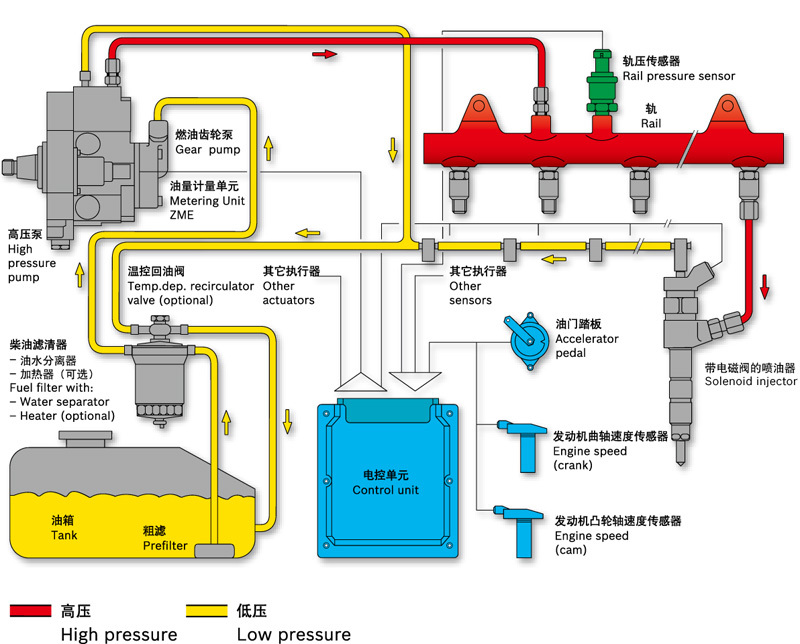
A high-pressure pump delivers fuel to a common supply rail, and precise control is achieved through rail pressure, so that high-pressure line pressure is independent of engine speed; this greatly reduces the variation of diesel supply pressure with engine speed.
World Leaders
Three major companies worldwide develop and producehigh-pressure common rail systems for diesel enginesnamely Denso (Japan), Bosch (Germany) and Ford (USA).Common Rail SystemA common rail system separates fuel pressure generation from injection. If unit pump injection was a revolution in diesel technology, common rail could be called a rebellion, since it departs from the conventional diesel system and resembles sequential petrol injection. Common rail opens up new ways to reduce diesel engine emissions and noise.
Thanks to its strong technical potential, manufacturers are now focused on the third generation of common rail, the piezo system, in which piezoelectric actuators replace solenoid valves for even more precise injection control. With no return line the structure is simpler; pressure is flexibly adjustable from 200 to 2,000 bar, and minimum injection quantity can be controlled to 0.5 mm3, reducing smoke and NOx emissions.
The growing energy crisis has become a focus of the global internal combustion engine industry and has increased interest in diesel engines. Compared with petrol engines, diesels offer many advantages: 20-25% lower CO2 emissions, better acceleration at low road speeds, 25-30% lower average fuel consumption and greater driving enjoyment. Forecasts have therefore been made for the share of diesels in global vehicle production by region. Emission control, however, remains a difficulty for diesels. To meet emission standards, advanced dieselFuel Injection System---high-pressure common rail technology has become a focus of the industry. In earlier years
the field was dominated by foreign suppliers, but that situation has now changed..
Emission Standards
On 30 December 2005 Beijing took the lead in implementing the China III emission standard. On 31 July 2006Shanghai public busesand new vehicles in the taxi fleet were required to meet China III, followed by Guangzhou on 1 September 2006 and nationwide application from 1 July 2007, with China IV planned for 2010.
Stricter emission standards inevitably drive engine technology. For petrol engines, mature technology and aftertreatment make current standards relatively easy to meet. For diesel engines, most still use mechanicalFuel Systemfuel systems and diesel direct injection has a short development history, so engines must be redesigned to meet emission requirements. Most Chinese manufacturers currently use licensed technology to meet China III, though some, such as FAW, are developing their own systems.Wuxi Fuel Injection Pump & Nozzle Research Institute, Chengdu Weite and others. Under stricter emission requirements, many new technologies have been introduced into the engine alongside electronically controlled fuel systems. Ricardo, the well-known automotive research organisation, recommends engine technologies for each emission stage; common rail, with its distinctive advantages, stands out as one of the most evolutionary and sustainable fuel injection systems.

 Nationwide Service Hotline
No. 2 Handa Road, Mazhu Town, Yuyao, Ningbo
sale@xmdiesel.com
0574-62425361
Copyright © 2020-2021 Ningbo Xingma Diesel Nozzle & Pump Co., Ltd. All rights reserved.
ICP Filing No.:Zhe ICP Bei 2020041404
The Xingma promise: quality products and first-class service for customers worldwide.

Service Hotline